

OSULLOC: The Korean Tea House of Jeju Island
OSULLOC: the tea house that put Korea back on the world map

When people think of premium Asian tea, most immediately think of Japan, China, sometimes Taiwan. Korea? Rarely. Yet the peninsula has been cultivating tea for over 1,200 years, and OSULLOC is the brand that, since 1979, has set out to reintroduce this forgotten heritage to the world. Born on the volcanic island of Jeju, raised by the Amorepacific group (the same house as Laneige, Innisfree, and Sulwhasoo), OSULLOC today embodies the Korean art of living in a cup.
At Ma Petite Corée, we immediately wanted to make room for OSULLOC on our shelves. Because a store celebrating K-culture without offering premium Korean tea is like a cosmetics house without its flagship serum. OSULLOC is that touch of slowness, ritual, and softness that perfectly accompanies a Korean skincare routine or a day watching K-dramas. In this article, we tell you everything: the brand’s story, Jeju’s terroir, the ranges to discover first, and how to prepare your tea like a true Korean.
1979 - 2025: the story of a Korean tea renaissance
The story begins with a visionary man: Suh Sung-whan, founder of the Amorepacific group. In the 1970s, he made an observation: the culture of Korean tea, a millennial heritage from the Silla kingdom, was disappearing. Economic modernization, urbanization, and industrialization had marginalized this know-how in favor of Western coffee. Suh Sung-whan then decided to do the unthinkable: buy hectares of uninhabited volcanic land on Jeju Island, south of the peninsula, and recreate tea plantations there.
The project is monumental. It requires clearing brush, testing the soil, selecting cultivars compatible with Jeju's oceanic climate, and waiting years before the first harvests. But in 1981, the first plants produce their first infusion. OSULLOC is officially born, with the mission to introduce the world to the richness of Korean tea and to create a modern lifestyle around this beverage. Today, the brand operates several plantations in Jeju — including the famous Seogwang Tea Plantation, which has become a major tourist attraction on the island — and also runs the OSULLOC Tea Museum, which welcomes over 2 million visitors annually.
By 2025, OSULLOC became much more than a brand: it is a symbol of Korean cultural renewal, alongside K-pop and K-beauty. With its design tea houses in Seoul, Tokyo, and New York, and its presence in global gourmet retailers, the brand has propelled Korean tea into international gastronomy.
Jeju terroir: why tea plants grow here like nowhere else

Jeju is not an ordinary island. Listed as a UNESCO World Heritage site, this volcanic island south of South Korea has a unique microclimate and soil that explain why OSULLOC chose this location rather than a plantation on the mainland. The basaltic soil, rich in minerals and perfectly drained, offers tea plants an environment very similar to the major tea regions of Japan (Uji, Kagoshima), but with a very specific aromatic signature.
Jeju's climate combines three key elements: moderate temperatures year-round (rarely below 5°C in winter, rarely above 30°C in summer), high humidity thanks to oceanic influence, and limited sun exposure due to frequent clouds. The result: tea leaves develop slowly, concentrating their aromas, antioxidants, and theanine (the amino acid that gives green tea its characteristic umami sweetness). This exact concentration is found in the OSULLOC Premium Matcha 40g at €24.90, a fine powder ceremonial matcha, bright green, traditionally prepared with a chasen (bamboo whisk) to achieve the creamy foam beloved by matcha enthusiasts.
OSULLOC plantations are certified organic: no pesticides, no chemical fertilizers, only natural compost and manual weeding methods. This requirement has a cost — the yield per hectare is lower than intensive farming — but it guarantees an aromatic purity that makes a difference in tasting.
Signature green teas: Sejak, Wedding Green Tea, and classics

The Sejak (작) is one of the four main classifications of Korean green tea, based on the harvest date. "Sejak" literally means "little sparrow," referring to the size of the young buds handpicked between late April and early May. These tender leaves from the first harvest contain the maximum delicate flavors and minimal bitterness. The OSULLOC Sejak Tea 10p at €21.90 is offered in individual pyramid sachets that preserve this exceptional quality — ideal for a daily cup without compromising on refinement.
Another essential: the OSULLOC Wedding Green Tea 10p at €19.90. As the name suggests, this tea was created to accompany Korean wedding ceremonies, traditionally served to guests as a sign of welcome and prosperity. It combines premium Jeju green tea with a very subtle floral aroma. It’s also a perfect gift for someone you love — the refined packaging and symbolism make the experience particularly elegant.
For a simpler daily routine, the OSULLOC Tea 20p at €15.90 is the brand’s "entry-level" reference — which, at OSULLOC, still means remarkable quality. 20 individual sachets of pure Jeju green tea, for about three weeks of morning ritual. A must-have to start an OSULLOC routine without breaking the bank.
Flavored infusions: when OSULLOC reinvents the classics

Where OSULLOC really stands out is in its flavored creations, which combine Korean expertise with inspirations from around the world. The OSULLOC Fig Apple Black Tea 10p at €17.90 is one of our absolute favorites: an elegant base black tea enhanced with dried figs and apples, evoking autumn afternoons in a Seoul café. Served hot with a touch of honey, it’s the definition of Korean comfort.
The OSULLOC Berry Garden Green Tea 10p at €17.90 is perfect for summer: Jeju green tea blended with a mix of red fruits (strawberry, blueberry, raspberry) that reveals its full splendor when cold brewed. Let it steep for 2 hours in the fridge, add some ice cubes and a slice of lemon — you have a refreshing drink far more interesting than a soda.
For a relaxing break at the end of the day, the OSULLOC Chamomile Blend 10p at €17.90 combines classic chamomile with original Korean notes (lemongrass, Jeju mandarin). The infusion is a bright golden yellow, the aroma is soothing, and the effect on sleep is real. Ideal for replacing a standard European herbal tea with something more refined.
OSULLOC milk teas: Korean dessert in a cup

OSULLOC’s "milk tea" range is one of the most popular among young Korean women — and it’s a range that has successfully crossed borders. The concept: soluble sticks containing tea (green, matcha, earl grey…) already pre-measured with sugar and milk powder. Just add hot water (or cold for an iced version) and stir. The result? A creamy milk tea, ready in 30 seconds, perfect when you don’t have the time or equipment to prepare a real matcha latte.
The OSULLOC Jeju Matcha Milk Tea 10p at €20.90 is our favorite: OSULLOC matcha in a creamy, slightly sweet version, with that characteristic bitterness that perfectly balances the milk’s sweetness. We love it hot in the morning as a coffee alternative, or iced in the afternoon as a tasty treat.
The OSULLOC Earl Grey Milk Tea 10p at €13.90 is the perfect entry-level option if you’re not a fan of matcha: black bergamot tea base + milk + sugar, like an English tea latte but with a Korean twist. A great gift for anyone wanting to explore the milk tea world without diving into the complexity of matcha.
The OSULLOC Moon Walk Tea 10p at €19.90 has a lovely name and gentle flavors of enriched jasmine tea. Its moon-inspired packaging also makes it an excellent gift.
OSULLOC Kombucha: a Korean fermented break

Kombucha, this fermented tea-based drink, is experiencing a huge resurgence in popularity worldwide — and Korea, a historic country of fermentations (kimchi, makgeolli, doenjang…), is no exception. The OSULLOC Kombucha Apple Pine at €16.90 is a particularly balanced Korean version: fermented Jeju green tea base, enhanced with notes of apple and pine (yes, pine — a classic ingredient in Korean cuisine). The result is sparkling, slightly tangy, refreshing, with a hint of aromatic mystery that sets it apart from European kombuchas.
Kombucha is also known for its probiotic properties: good for gut flora, a source of B vitamins, and rich in antioxidants thanks to its green tea base. It's the perfect drink to replace a soda or accompany a Korean brunch. Best served chilled, with or without ice.
How to prepare your OSULLOC tea like a Korean woman

For pyramid tea bags: use filtered water heated to 70-80°C (never 100°C — boiling water burns green tea and makes it bitter). Let infuse for 2 to 3 minutes, no more. The same OSULLOC bag can be re-infused twice: the first infusion is milder, the second reveals deeper notes.
For powdered matcha: 1 matcha spoon (~2 g) in a warmed bowl, add 60 ml of water at 80°C, whisk vigorously with a chasen (bamboo whisk) or, if unavailable, an electric milk frother, making a "W" motion until a fine foam forms. For a matcha latte, then add 120 ml of hot milk (plant-based or regular) previously frothed.
For milk teas in sticks: one stick in a cup, 200 ml of water at 85°C, stir for 20 seconds. For an iced version, mix the stick with 100 ml of hot water, then add 100 ml of very cold water and ice cubes.
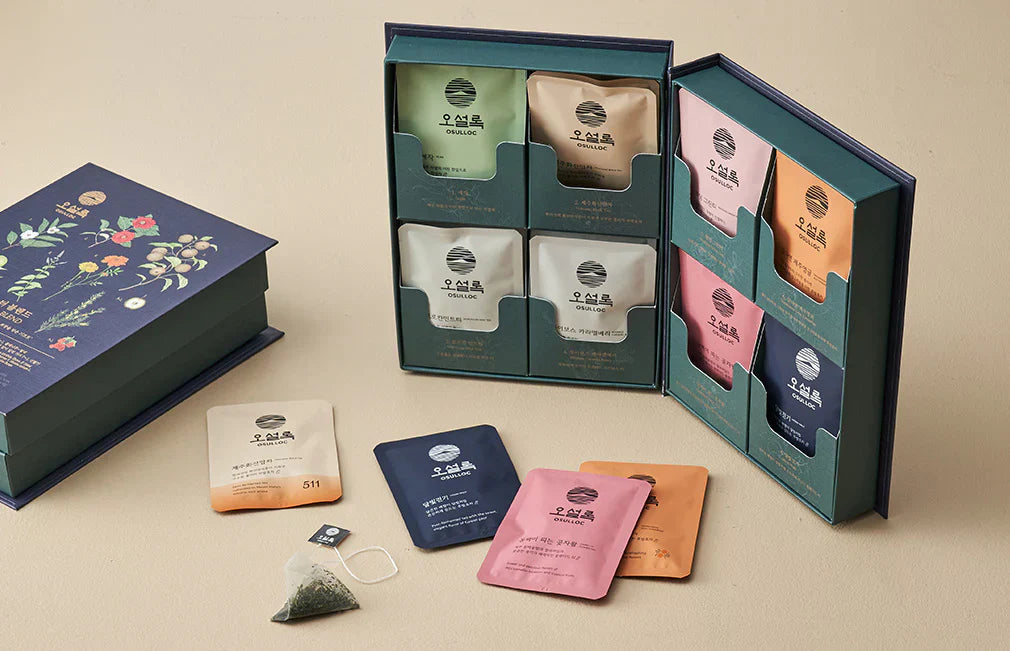
Want to try several ranges at once? The OSULLOC Lovely Tea Box Set at €26.90 is a perfect discovery box, with an assortment of the most popular teas. Ideal as a gift or for yourself, to start the OSULLOC adventure without mistakes.
Our OSULLOC best-sellers on Ma Petite Corée
To help you navigate the range, here is our selection of the most ordered OSULLOC teas by our community. All in stock, fast delivery from France.

OSULLOC is the brand we give to those we love, keep for ourselves when we want to slow down, and rediscover every season thanks to its flavored creations. With Ma Petite Corée, we bring this Korean way of life directly to your home — in just a few days, without having to cross Eurasia. Take a cup, breathe, and let Jeju infuse.
— Yeseo, Ma Petite Corée team 🍵